

Pain During Exercise: Should You Back Off or Push Through?
Pain during exercise does not always mean that you are causing tissue damage. However, it should not automatically be ignored either.
Understanding the difference between expected exercise discomfort and symptoms that may indicate you should reduce your training load can help you exercise more confidently and safely.
For many people, particularly those managing persistent musculoskeletal conditions, the best approach is not simply to stop whenever something hurts or to push through at all costs. Instead, consider the intensity and nature of your symptoms, whether your movement changes and how your body responds afterwards.
Does Pain Mean You Are Causing Damage?
Not necessarily.
Pain is a complex protective experience influenced by many factors, including:
- Tissue irritation or injury
- Previous injuries
- Sensitivity of the nervous system
- Fatigue
- Stress
- Sleep
- Expectations and previous experiences
- Current physical capacity
The intensity of what someone feels does not always correspond directly with the amount of tissue damage present.
This is particularly relevant for people experiencing persistent or chronic musculoskeletal issues. In some longer-term conditions, the nervous system can become more sensitive. As a result, activities that were previously comfortable may begin to provoke symptoms even when they are not causing new tissue damage. For this reason, avoiding every movement that produces discomfort may sometimes contribute to reduced activity, deconditioning and lower confidence in movement.
However, this does not mean that symptoms should simply be ignored.
The context matters.
Should You Exercise Through Pain?
Sometimes mild discomfort during exercise can be acceptable, particularly during rehabilitation for certain persistent musculoskeletal conditions. Research comparing exercise performed with some symptoms against completely symptom-free exercise has found that allowing tolerable discomfort during therapeutic exercise does not necessarily result in worse outcomes. Some studies have also reported small short-term benefits from exercise performed within a manageable symptom range. However, neither approach appears consistently superior over the longer term.
The important message is that pain during exercise does not automatically mean exercise needs to stop.
Instead, consider:
- Pain intensity
- The type of Pain
- Changes in movement
- How quickly symptoms settle
- Your normal baseline
- Recent injuries
- Your diagnosis or condition
- Advice from your healthcare practitioner
A gradual and appropriate increase in exercise load is usually more useful than either complete avoidance or repeatedly pushing through significant discomfort.
Why Avoiding Exercise Can Sometimes Make Symptoms Worse
Fear of discomfort can influence how much people move.When someone repeatedly avoids movement because they expect it to hurt, their physical capacity can gradually decrease.
Over time, this may contribute to:
- Reduced strength
- Reduced cardiovascular fitness
- Lower tolerance to physical activity
- Increased stiffness
- Reduced confidence in movement
- Greater sensitivity to activity
This does not mean you should ignore warning signs.
Instead, the aim is to find a manageable level of exercise that allows your body to gradually adapt.
The Traffic Light Framework
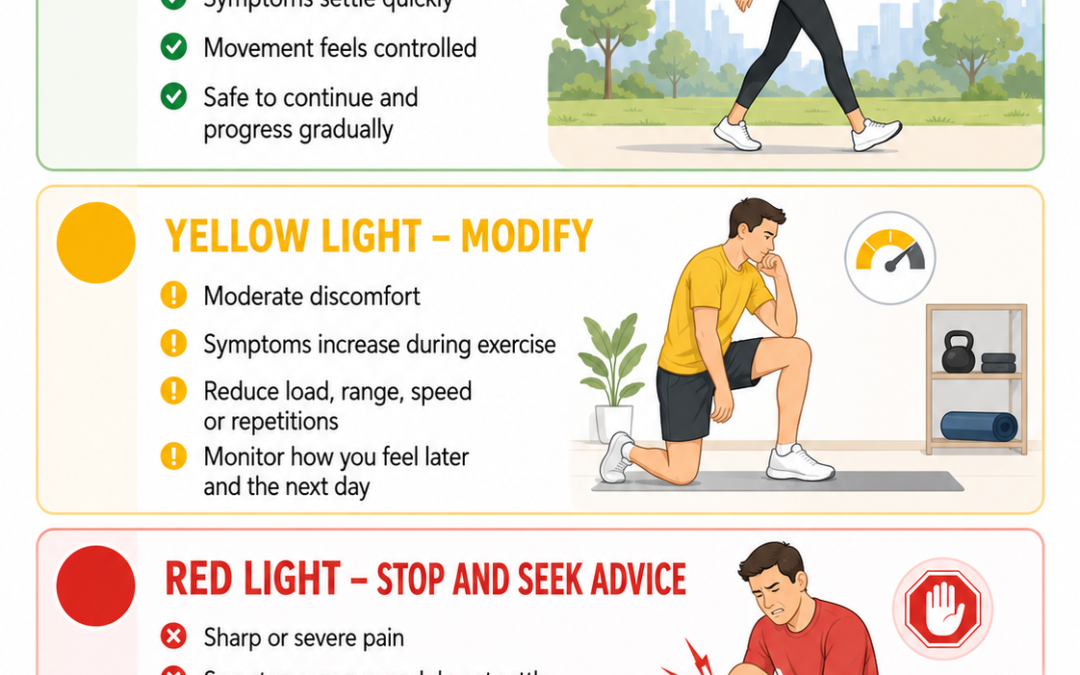
A simple traffic light system can help you decide whether to continue, modify or stop an exercise.
These numbers are general guidelines rather than strict rules. Different injuries and conditions may require different limits.
Green Light: Continue
Pain is approximately 0–3/10 during exercise.
You may generally continue if:
- Discomfort remains mild
- Your movement remains normal
- Symptoms settle soon after exercise
- You return to your usual baseline by the following day
This response usually suggests that the current exercise load is being tolerated reasonably well.
Yellow Light: Reduce or Modify the Load
Pain is approximately 4–5/10, particularly if they are increasing or taking longer than usual to settle.
Consider:
- Reducing the weight
- Decreasing repetitions
- Reducing the range of movement
- Slowing the exercise
- Taking a longer recovery period
- Temporarily changing the exercise
You should also monitor how you feel later that day and the following morning.
If symptoms repeatedly remain elevated, your current training load may need adjustment.
Red Light: Stop and Assess
Pain is around 6/10 or greater, rapidly increasing discomfort or significant changes in function should generally prompt you to stop or substantially modify the activity.
You should also seek professional assessment when symptoms are unusual, severe or continuing to worsen.
When Should You Stop Exercising?
The decision to stop should consider more than intensity alone.
Stop the exercise and consider seeking assessment if you experience:
- Sharp or severe symptoms
- Rapidly worsening discomfort
- Symptoms following significant injury or trauma
- Sudden loss of strength
- New numbness or tingling
- Significant weakness
- Loss of balance or coordination
- Symptoms that substantially change the way you move
- Significant guarding or inability to use the affected area normally
- A response that remains noticeably worse than your usual baseline the following day
Certain symptoms may require more urgent medical assessment, particularly when they are sudden or severe.
What If Symptoms Are Worse the Day After Exercise?
Your response over the following 12–24 hours can provide useful information about whether the exercise load was appropriate. A small temporary increase in discomfort may sometimes occur during rehabilitation. However, if your symptoms are substantially worse the following day, you may have progressed the exercise too quickly.
You may need to adjust:
- Exercise intensity
- Weight
- Volume
- Frequency
- Range of motion
- Recovery time
This is one reason rehabilitation programs are usually progressed gradually rather than increasing everything at once.
Is Muscle Soreness the Same as Pain?
Not always.
Delayed onset muscle soreness (DOMS) commonly develops after unfamiliar or challenging exercise.
It may cause:
- Muscle tenderness
- Stiffness
- General aching
- Temporary discomfort with movement
DOMS often develops within several hours of exercise and may be most noticeable one or two days later.
This is different from sudden sharp pain, significant joint symptoms or discomfort associated with an acute injury.
Learning to recognise the difference between normal post-exercise soreness and potentially concerning symptoms can make exercise progression easier.
How Much Pain Is Acceptable During Rehabilitation?
There is no single level that is appropriate for every injury or every person. Mild symptoms may be acceptable during rehabilitation for some conditions, while other injuries may require a more cautious approach.
Factors that influence acceptable exercise intensity include:
- Your diagnosis
- Stage of healing
- Recent injury
- Tissue involved
- Current strength and fitness
- Previous training history
- Your usual symptom levels
- Your rehabilitation goals
For this reason, a personalised exercise program is often preferable when symptoms are persistent, recurring or difficult to interpret.
The Bottom Line: Should You Push Through?
The answer is usually not simply yes or no.
Mild discomfort during exercise can sometimes be acceptable, particularly during rehabilitation for persistent musculoskeletal conditions. However, significant, rapidly worsening or unusual symptoms should not simply be pushed through.
A useful approach is to monitor:
- How intense is it?
- What does it feel like?
- Does it change the way you move?
- Does it settle after exercise?
- How do you feel the following morning?
The goal is not to eliminate every sensation during exercise.
Equally, the goal is not to train through significant symptoms regardless of the consequences. Instead, aim for gradual, progressive loading within a level your body can tolerate and recover from.
If you are unsure whether pain during exercise is appropriate for your condition, an assessment with a qualified healthcare or exercise professional can help determine a suitable starting point and progression.
Book your initial assessment today!
This information is general in nature and does not replace individual medical or healthcare advice. Exercise recommendations should be adapted to your individual condition, symptoms and health history.
Recent Comments