

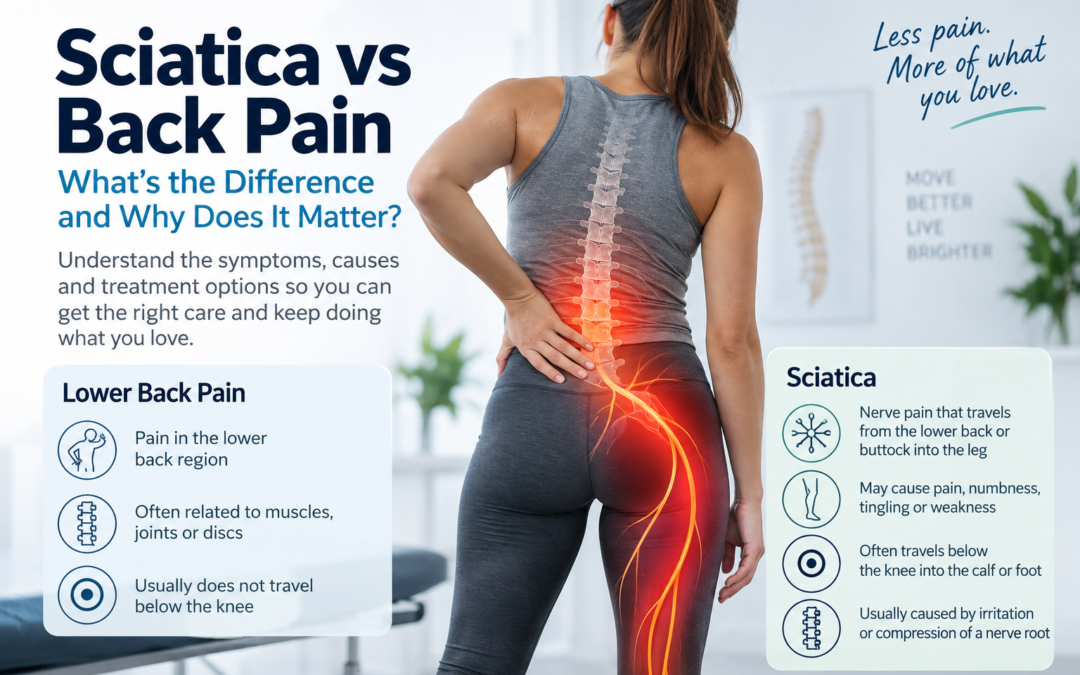
Sciatica vs Back Pain: What’s the Difference?
Sciatica and lower back pain are common musculoskeletal problems, but they are not the same condition.
Both can begin in the lower back. Both can affect movement, sitting, exercise and everyday activities. However, sciatica usually involves irritation or compression of a nerve root, while many forms of lower back pain do not involve the nervous system.
Understanding the difference between sciatica vs back pain can help guide an appropriate assessment and treatment plan.
What Is Lower Back Pain?
Lower back pain refers to pain or discomfort in the area between the lower ribs and the buttocks.
It can develop for many reasons, including:
- Muscle or ligament strain
- Joint irritation
- Changes associated with the spinal discs
- Increased or unfamiliar physical loads
- Prolonged sitting or repetitive movements
- Injury or trauma
Symptoms can vary considerably between people.
Some people experience a dull ache or stiffness. Others notice sharper pain with certain movements, such as bending, lifting or changing position. Lower back pain may also spread into the buttocks or upper thigh. However, lower back pain without nerve involvement does not usually produce neurological symptoms such as numbness, tingling or muscle weakness in the leg.
What Is Sciatica?
Sciatica describes nerve-related pain that travels along the distribution of the sciatic nerve. The sciatic nerve is the largest nerve in the body. It is formed from nerve roots originating in the lower lumbar and sacral spine. Sciatica commonly develops when one or more of these nerve roots become irritated or compressed.
Symptoms may travel from the lower back or buttock into the:
- Back of the thigh
- Calf
- Foot
- Toes
It commonly affects one side of the body.
However, symptoms can vary depending on which nerve root is affected and the severity of the irritation.
What Does it Feel Like?
It can cause more than pain.
Common symptoms may include:
- Pain travelling down the leg
- Burning sensations
- Pins and needles
- Tingling
- Numbness
- Altered sensation
- Muscle weakness
For some people, leg pain may be more noticeable than the pain in their lower back.
This is one of the features that can help distinguish nerve-related pain from uncomplicated lower back pain.
What Causes it?
Sciatica is better thought of as a symptom of nerve irritation or compression rather than a condition on its own.
Possible causes include:
- Lumbar disc herniation
- Disc-related nerve irritation
- Spinal stenosis
- Degenerative changes around the spine
- Other conditions that place pressure on a lumbar or sacral nerve root
However, pain travelling into the leg does not automatically mean that someone has sciatica.
For this reason, an appropriate clinical assessment is important.
Sciatica vs Back Pain: Key Differences
Distinguishing between the two is not always straightforward. In fact, the two can occur together.
However, several features can suggest greater involvement of a spinal nerve.
Ask yourself:
- Does the pain travel below the knee?
- Does it extend into the calf or foot?
- Is the leg pain worse than the lower back pain?
- Do you have numbness or tingling?
- Have you noticed weakness in your leg or foot?
- Does the pain follow a relatively consistent pathway down one leg?
If one or more of these symptoms are present, nerve involvement may be possible.
A professional assessment can help determine whether the symptoms are consistent with sciatica or another cause of back and leg pain.
Why Does the Difference Matter?
Identifying the likely source of symptoms can help guide treatment.
Treatment for uncomplicated lower back pain may include:
- Gradually restoring movement
- Appropriate exercise
- Strengthening
- Manual therapy where appropriate
- Activity modification
- Advice about work, posture and physical loading
Sciatica may require a somewhat different approach because a nerve root is involved.
Management may include:
- Maintaining appropriate movement
- Gradual exercise
- Strength and mobility rehabilitation
- Neural mobility exercises when suitable
- Modifying activities that aggravate symptoms
- Monitoring neurological symptoms
- Managing the underlying cause of nerve irritation
Treatment should therefore be based on the individual presentation rather than simply the location of the pain.
How Is Sciatica Assessed?
A clinical assessment usually begins with questions about your symptoms and medical history.
Your practitioner may ask:
- Where does the pain begin?
- How far does it travel?
- What movements make it better or worse?
- Do you have numbness or tingling?
- Have you experienced weakness?
- Has your walking or balance changed?
A physical examination may then assess:
- Spinal movement
- Hip movement
- Muscle strength
- Reflexes
- Sensation
- Nerve function
- Functional movements
These findings help determine whether nerve involvement is likely and whether further investigation may be required.
Do You Need an MRI for Sciatica?
Not everyone with sciatica needs an MRI.
In many cases, the pattern of symptoms and findings from a physical examination provide useful information about the likely cause. Imaging may be considered when symptoms are severe, persistent, worsening or associated with significant neurological changes. Your practitioner can advise whether further investigation or referral is appropriate.
When Should You Seek Assessment for Sciatica or Back Pain?
Many episodes of back pain and sciatica improve with appropriate management.
However, you should seek professional assessment if your pain:
- Persists or continues to worsen
- Travels significantly into your leg
- Is interfering with work or sleep
- Prevents normal exercise or daily activities
- Is associated with numbness or weakness
- Developed following significant trauma
An assessment can help identify the likely cause and guide a treatment and rehabilitation plan.
When Is Back Pain or Sciatica an Emergency?
Some symptoms require urgent medical assessment.
Seek urgent medical care if back or leg pain is accompanied by:
- Loss of bladder or bowel control
- Numbness around the groin or saddle area
- Significant or rapidly worsening weakness
- Weakness or numbness affecting both legs
- Severe symptoms following major trauma
These symptoms may indicate a more serious neurological or spinal condition and should not be ignored.
Can Exercise Help Sciatica?
Exercise can form an important part of rehabilitation for many people with sciatica. However, the type and intensity of exercise should depend on the individual presentation.
A rehabilitation program may gradually work on:
- Spinal and hip movement
- Lower-limb strength
- Core and trunk strength
- General fitness
- Movement confidence
- Tolerance to sitting, walking and lifting
- Returning to work, sport or exercise
The aim is generally to restore function while gradually increasing the amount of activity the person can comfortably tolerate.
Sciatica and Back Pain Assessment in Brisbane
If you have lower back pain, sciatica or pain travelling into your leg, determining the likely source of your symptoms is an important first step. At the Institute of Sports and Spines in Tingalpa, Brisbane, our practitioners assess and manage a range of lower back, leg and nerve-related musculoskeletal conditions. Assessment focuses on identifying the factors contributing to your symptoms and developing an individual treatment and rehabilitation plan.
If your symptoms require further investigation or another type of medical assessment, an appropriate referral can also be recommended.
Frequently Asked Questions About Sciatica
Is sciatica the same as lower back pain?
No. Lower back pain refers to pain in the lower back region. Sciatica specifically describes nerve-related symptoms that typically travel from the lower back or buttock into the leg.
Can you have sciatica without back pain?
Yes. Some people experience relatively little back pain but significant pain, numbness or tingling in the buttock, thigh, calf or foot.
Does sciatica always travel below the knee?
Not always. However, pain travelling below the knee into the calf or foot can increase suspicion of nerve root involvement.
Is numbness a symptom of sciatica?
It can be. Sciatica may cause numbness, tingling, burning or altered sensation depending on the nerve involved.
How long does sciatica last?
Recovery time varies considerably. It depends on the underlying cause, severity of symptoms, neurological involvement, general health and other individual factors.
Should I rest if I have sciatica?
Prolonged complete rest is generally not the goal. Appropriate movement and gradual activity are often part of management, although activities may need to be modified depending on symptoms.
Contact us:
At the Institute of Sports and spines, out team is experienced in assessing and managing both low back and sciatica pain. To make an appointment, click here, or call us on (07) 3398 7022.
Recent Comments