

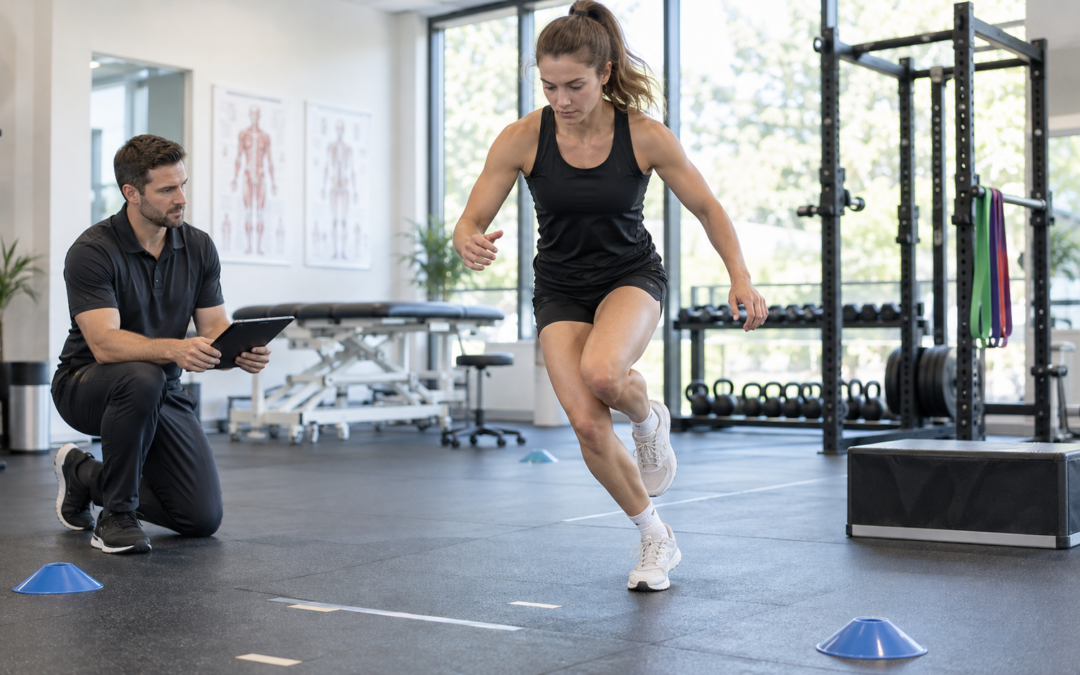
Return to Sport Physiotherapy: Why Time Alone Is Not Enough
Returning to sport after an injury involves much more than waiting for pain to settle or reaching a certain number of weeks after the injury.
Return to sport physiotherapy helps bridge the gap between injury recovery and the physical demands of training and competition. It focuses on restoring strength, movement, control, speed, confidence and the ability to tolerate sport-specific loads.
Time is certainly an important part of tissue healing. However, time alone does not restore physical capacity.
For this reason, a well-planned return to sport should consider objective strength and functional testing, alongside symptoms, healing time and the demands of the athlete’s chosen sport.
What Happens to the Body After a Sports Injury?
Following a sports injury, the body begins a natural healing process.Initially, there may be pain, swelling and reduced movement. Over time, these symptoms often improve. Range of motion may return and everyday activities can become comfortable again.
However, feeling better during normal daily activities does not necessarily mean the body is ready for sport.
Sport can require the body to:
- Generate high levels of force
- Absorb force during landing and deceleration
- Sprint or run at high speed
- Jump and land repeatedly
- Accelerate and change direction
- React quickly to unpredictable situations
- Perform skills under fatigue
- Tolerate repeated training sessions and competition
These abilities often need to be progressively rebuilt during sports injury rehabilitation.
This is particularly important following injuries such as:
- ACL injuries and reconstruction
- Hamstring strains
- Ankle sprains
- Calf injuries
- Tendon injuries
- Knee injuries
- Muscle tears
- Shoulder injuries
- Fractures
- Surgery
Therefore, rehabilitation should not stop simply because pain has improved.
Why Time Alone Is Not Enough for Return to Sport
Traditionally, athletes were sometimes cleared to return to sport after reaching a particular point in their recovery. For example, someone might be told they could return six weeks, three months or nine months after an injury. Healing time remains important. However, a calendar cannot measure strength, balance, movement quality or sporting capacity.
A person may be pain-free but still have:
- Reduced muscle strength
- Poor balance or coordination
- Reduced power
- Differences between the injured and uninjured side
- Reduced running capacity
- Poor landing control
- Difficulty changing direction
- Reduced confidence in the injured area
- Poor tolerance to fatigue
These deficits may not be obvious during walking or normal daily activities.
This is why return to sport physiotherapy increasingly uses criteria-based progression rather than relying on time alone. In ACL rehabilitation, for example, clinical guidelines recommend considering functional criteria alongside the time since surgery when progressing rehabilitation and planning a return to sport (van Melick et al., 2016).
The Difference Between Healing and Being Ready for Sport
There is an important difference between an injury being clinically healed and an athlete being physically prepared for sport.
Imagine a football player recovering from a knee injury.
They may be able to:
- Walk without pain
- Climb stairs comfortably
- Jog in a straight line
- Perform basic gym exercises
However, football may also require them to sprint, stop suddenly, change direction, jump, land, tackle and respond to another player’s movements. Similarly, a runner may feel comfortable walking but still need to rebuild their ability to tolerate repeated impact over several kilometres.
Therefore, injury recovery should progressively expose the body to the demands it will eventually face.
Why Weakness and Movement Compensation Can Persist
One common issue after injury is compensation. People naturally try to protect an injured area. While this can be useful during the early stages of recovery, some protective movement patterns may remain after symptoms improve.
For example, following a knee injury, an athlete might:
- Place less weight through the injured leg
- Land more heavily on the opposite side
- Reduce knee bend when landing
- Shift their body away from the injured side
- Avoid powerful movements
- Hesitate before changing direction
These strategies may not always be obvious to the athlete. Strength testing and functional assessment can help identify these differences.
After ACL reconstruction, research has also highlighted the importance of quadriceps strength symmetry and appropriately timed progression when considering reinjury risk (Grindem et al., 2016). Therefore, ACL rehabilitation commonly includes both strength assessment and functional return to sport testing.
What Is Return to Sport Testing?
Return to sport testing is a group of physical assessments used to evaluate whether an athlete has regained important qualities required for their sport. There is no single test that can determine whether someone is completely ready to return.
Instead, testing should consider several areas of performance. Depending on the injury and sport, testing may include:
Strength Testing
Strength testing can identify differences between the injured and uninjured side and assess whether key muscle groups have regained sufficient capacity.
Examples may include testing:
- Quadriceps strength
- Hamstring strength
- Calf strength
- Hip strength
- Upper-body strength
Objective testing can provide more useful information than simply asking whether an exercise feels strong.
Hop and Jump Testing
Hop testing is often used during lower-limb rehabilitation.
Tests may examine:
- Single-leg hopping
- Repeated hopping
- Hop distance
- Lateral hopping
- Jump and landing control
These tests can assess both physical performance and differences between limbs.
Landing Assessment
Landing tasks can provide information about how an athlete absorbs force.
A physiotherapist may assess:
- Knee and hip position
- Trunk control
- Balance
- Limb symmetry
- Ability to absorb force
- Control during repeated tasks
Running Assessment
For athletes involved in running-based sports, rehabilitation may progressively assess:
- Running tolerance
- Running speed
- Acceleration
- Deceleration
- Sprinting
- Repeated running efforts
Change-of-Direction Testing
Field and court sports frequently involve rapid changes in direction. Rehabilitation may therefore include cutting, turning, side-stepping and reactive movement drills.
Fatigue Testing
An athlete may perform well when fresh but lose movement control or strength as fatigue develops. For this reason, some return to sport testing should eventually assess performance after repeated efforts.
Return to Sport Rehabilitation Should Be Progressive
A return to sport program should gradually move from basic rehabilitation exercises towards the demands of the athlete’s sport.
Early rehabilitation might focus on:
- Pain and swelling management
- Restoring movement
- Rebuilding basic strength
- Improving balance and control
Later rehabilitation can progress towards:
- Heavy strength training
- Running
- Plyometric exercises
- Jumping and landing
- Sprinting
- Change-of-direction training
- Sport-specific drills
- Repeated high-intensity efforts
The aim is not simply to remove pain.
The goal is to rebuild the body’s ability to tolerate the forces and movements required during sport.
Return to Training Is Not Always the Same as Return to Competition
Another important distinction is the difference between returning to training and returning to full competition. These are often separate stages.
A gradual progression may involve:
- Rehabilitation exercises
- Individual running or sport-specific drills
- Modified team training
- Full training
- Limited competition exposure
- Full return to competition
This progression allows the body to adapt while giving the athlete and clinician opportunities to monitor symptoms, fatigue and confidence.
In many cases, jumping directly from rehabilitation into full competition creates a much larger change in workload.
Confidence Is Also Part of Returning to Sport
Physical testing is important, but psychological readiness also matters.
Following a significant injury, athletes may worry about:
- Reinjuring themselves
- Landing on the injured leg
- Sprinting at full speed
- Changing direction
- Contact with another player
- Returning to their previous level of performance
Some hesitation is understandable, particularly after a serious injury or surgery.
Progressively exposing the athlete to increasingly sport-specific activities can help rebuild confidence alongside physical capacity.
Questions a Return to Sport Assessment Should Answer
A useful return to sport assessment should look beyond whether pain has disappeared.
Instead, it should help answer questions such as:
Can you produce enough force?
Strength and power are important for running, jumping, tackling and changing direction.
Can you absorb force safely?
Landing, stopping and decelerating place significant loads through the body.
Are there meaningful differences between sides?
Large strength or performance differences may indicate areas that require further rehabilitation.
Can you perform when fatigued?
Sport is rarely performed while completely fresh.
Can you tolerate sport-specific movements?
Rehabilitation should eventually resemble the movements, speed and intensity required in the athlete’s sport.
Do you trust the injured area?
Confidence can influence how freely someone moves when returning to training and competition.
When Should You Consider a Return to Sport Physiotherapy Assessment?
You may benefit from a return to sport assessment if you:
- Feel better but are unsure whether you are ready to compete
- Still notice weakness on the injured side
- Have recurrent swelling after training
- Feel unstable during running or changing direction
- Are hesitant during jumping or landing
- Have difficulty returning to your previous speed
- Have completed rehabilitation but have not undergone objective testing
- Have experienced repeated injuries
- Are returning after ACL reconstruction or another significant injury
Assessment can identify which aspects of rehabilitation have recovered well and which areas may still require work.
Return to Sport Physiotherapy in Tingalpa
At the Institute of Sports and Spines in Tingalpa, our physiotherapists use strength assessment, functional testing and progressive rehabilitation to help guide return-to-sport decisions.
The process is tailored to the individual because the demands of sport vary considerably. For example, the physical requirements of running are different from rugby, football, basketball, netball, cricket or martial arts.
Therefore, your rehabilitation should consider not only the injury but also your sport, position, training history and performance goals. Rather than simply asking, “Has enough time passed?”, return to sport physiotherapy asks a more useful question:
“Have you rebuilt the physical capacity required to perform your sport?”
Objective assessment can help identify remaining gaps and provide a clearer pathway from rehabilitation back to training and competition.
Frequently Asked Questions About Return to Sport Physiotherapy
What is return to sport physiotherapy?
Return to sport physiotherapy is the later stage of sports injury rehabilitation. It focuses on rebuilding strength, power, movement control, running ability and sport-specific capacity before returning to training and competition.
How do I know when I am ready to return to sport?
Readiness should consider several factors, including healing time, symptoms, strength, function, sport-specific performance and confidence. Objective return to sport testing can help identify areas that may still require rehabilitation.
Can I return to sport if I have no pain?
Being pain-free is encouraging, but it does not necessarily mean you have fully restored strength, power, balance or sport-specific capacity. These qualities may need to be assessed separately.
What tests are used before returning to sport?
Testing depends on the injury and sport. It may include strength testing, hop tests, jump and landing assessment, running tests, change-of-direction testing and sport-specific drills.
Why is strength testing important after ACL reconstruction?
ACL injury and reconstruction can result in persistent quadriceps weakness and differences between limbs. Objective strength testing can help identify these deficits and guide ACL rehabilitation and return-to-sport progression.
Do I need return to sport testing after every injury?
Not every minor injury requires extensive testing. However, objective assessment becomes more important following significant injuries, surgery, recurrent injuries or when returning to sports involving high speeds, jumping, cutting, contact or rapid changes in direction.
References
Grindem, H., Snyder-Mackler, L., Moksnes, H., Engebretsen, L., & Risberg, M. A. (2016). Simple decision rules can reduce reinjury risk after anterior cruciate ligament reconstruction: The Delaware-Oslo ACL cohort study. British Journal of Sports Medicine, 50(13), 804–808.
https://doi.org/10.1136/bjsports-2016-096031
van Melick, N., van Cingel, R. E. H., Brooijmans, F., et al. (2016). Evidence-based clinical practice update: Practice guidelines for anterior cruciate ligament rehabilitation based on a systematic review and multidisciplinary consensus. British Journal of Sports Medicine, 50(24), 1506–1515.
https://doi.org/10.1136/bjsports-2016-096278
Recent Comments