

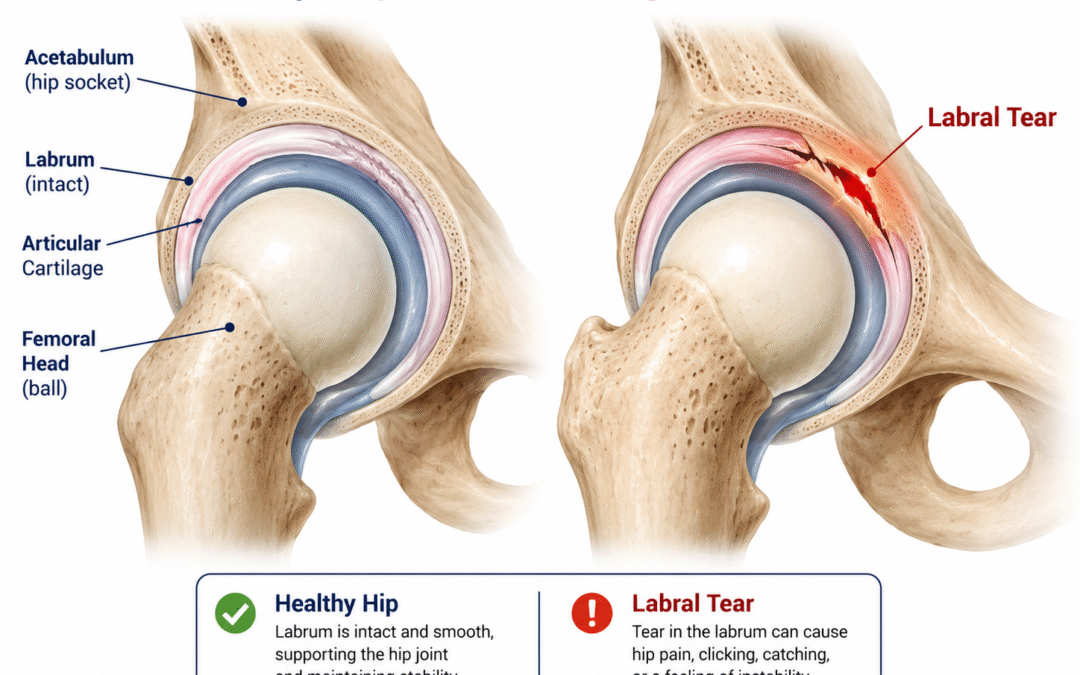
Chiropractic for Hip Labral Tear: Symptoms, Treatment and Exercises
By Jodi Floyd,
A hip labral tear affects the ring of cartilage around the socket of the hip joint. It may cause groin pain, hip stiffness, clicking, catching or difficulty with activities such as sitting, twisting, walking and exercising.
Chiropractic care for a hip labral tear does not aim to repair the torn cartilage directly. Instead, treatment may focus on identifying the factors contributing to your symptoms, improving movement around the hip and pelvis, strengthening the surrounding muscles and gradually rebuilding your tolerance for daily activities and exercise.
Not every labral tear causes pain. The significance of a tear depends on your symptoms, hip structure, physical demands and findings from a clinical assessment.
What Is the Hip Labrum?
The hip is a ball-and-socket joint.
The rounded head of the thigh bone, known as the femoral head, sits inside a socket in the pelvis called the acetabulum.
The hip labrum is a ring of fibrocartilage around the edge of the socket. It helps to:
- deepen the hip socket
- support joint stability
- maintain lubrication within the joint
- distribute load around the hip
- create a seal around the femoral head
- support smooth movement of the hip
A hip labral tear occurs when part of this cartilage becomes damaged or separates from the edge of the socket.
What Causes a Hip Labral Tear?
A hip labral tear may develop due to one factor or a combination of factors.
Common causes and contributing factors include:
- a sporting or traumatic injury
- repeated twisting or pivoting
- repetitive hip loading
- deep hip flexion and rotation
- femoroacetabular impingement
- hip dysplasia or a shallow hip socket
- joint instability or increased flexibility
- age-related or degenerative changes
- reduced strength or control around the hip and pelvis
Sports that involve repeated rotation, deep hip positions or rapid changes of direction may place greater demand on the labrum.
However, a tear identified on an MRI does not automatically mean that it is the only cause of the person’s pain. Imaging findings should always be considered alongside symptoms and physical examination findings.
Common Hip Labral Tear Symptoms
Some hip labral tears do not produce noticeable symptoms.
When symptoms are present, they may include:
- groin pain
- pain at the front or side of the hip
- buttock pain
- clicking, catching or locking sensations
- hip stiffness
- reduced range of motion
- discomfort after prolonged sitting
- pain when twisting or pivoting
- pain during walking or running
- difficulty getting in or out of a car
- pain during deep squats or lunges
- reduced confidence with exercise or sport
Groin pain is common, but symptoms may also be felt around the side or back of the hip.
Clicking alone does not confirm a labral tear. Muscles, tendons and other structures around the hip can also create clicking or snapping sensations.
How Is a Hip Labral Tear Assessed?
A chiropractic assessment usually begins with a detailed discussion of your symptoms, medical history, activity levels and treatment goals.
Your chiropractor may ask about:
- how the symptoms started
- whether there was an injury
- which movements aggravate the hip
- clicking, locking or instability
- previous hip, pelvis or lower-back problems
- work, exercise and sporting demands
- previous scans or treatment
- activities you want to return to
The physical examination may assess:
- hip range of motion
- strength around the hip and pelvis
- trunk and core control
- walking and movement patterns
- balance and single-leg control
- lower-back and pelvic movement
- nerve function
- squatting, stepping and lifting
- movements that reproduce your symptoms
This helps determine whether your symptoms may be influenced by the hip joint, surrounding muscles, tendons, lower back, pelvis or a combination of these factors.
Do You Need an MRI for a Hip Labral Tear?
An MRI may provide information about the labrum and other soft tissues around the hip.
X-rays may also be used to assess:
- the shape of the hip joint
- femoroacetabular impingement
- hip dysplasia
- arthritis
- previous injury
- other structural changes
However, imaging is not always required before beginning conservative treatment.
A scan result should not be interpreted in isolation. Some people have labral changes on imaging without experiencing hip pain.
Your chiropractor may recommend referral to a general practitioner, sports physician or orthopaedic specialist when imaging or further medical investigation is appropriate.
How Can Chiropractic Care Help a Hip Labral Tear?
Chiropractic care for a hip labral tear may focus on reducing aggravating factors and improving how the hip, pelvis and lower limb manage physical load.
Treatment may include:
- education about the condition
- advice on sitting and daily activities
- temporary activity modification
- hip and pelvic mobility treatment
- soft-tissue techniques
- joint mobilisation or manipulation where appropriate
- hip and gluteal strengthening
- trunk and pelvic control exercises
- movement retraining
- balance and single-leg exercises
- gradual return to running or sport
- management of training load
- referral for imaging or specialist assessment when needed
Treatment should be based on your individual presentation.
Manual treatment may help reduce pain or stiffness for some people. However, it should generally be combined with exercise, education and a gradual return to normal activity.
Can Chiropractic Treatment Heal a Torn Hip Labrum?
Chiropractic treatment cannot physically reattach a torn labrum.
However, many people with labral tears can improve their pain and function without surgery.
Conservative treatment may help by:
- reducing irritation
- improving hip and pelvic movement
- strengthening the muscles that support the joint
- improving movement control
- reducing unnecessary stress on the hip
- gradually rebuilding activity tolerance
- helping the person return to work, exercise or sport
The aim is to improve function and reduce symptoms rather than focusing only on the appearance of the tear on imaging.
Activities That May Aggravate a Hip Labral Tear
There is no universal list of activities that every person with a hip labral tear must avoid.
Instead, identify the movements that cause sharp pain, pinching, catching or a prolonged increase in symptoms.
Complete rest is rarely the long-term solution. Activities can often be modified temporarily and gradually reintroduced as strength and tolerance improve.
Deep Hip Rotation and Yoga Positions
Deep hip flexion combined with internal or external rotation may aggravate symptoms in some people.
Potentially provocative positions include:
- lotus pose
- pigeon pose
- lizard pose
- happy baby pose
- frog pose
- deep twisting positions
You may not need to stop yoga completely.
Consider:
- reducing the depth of the position
- using blocks, cushions or supports
- avoiding forced end-range movement
- shortening the time spent in the position
- stopping if the movement causes sharp pain or catching
- selecting alternative poses
The goal is to maintain comfortable movement without repeatedly irritating the hip.
Deep or Prolonged Stretching
Aggressive stretching is not always helpful for hip joint pain.
Long or forceful hip flexor, hamstring or groin stretches may aggravate symptoms when they place the hip into a compressed or painful position.
When stretching:
- stay within a comfortable range
- avoid forcing the joint
- use shorter holds
- focus on gentle movement
- stop if symptoms increase
- monitor how the hip feels afterwards
Some people need improved mobility, while others already have sufficient or excessive hip movement. Your chiropractor can help determine whether stretching is appropriate.
Twisting and Pivoting Sports
Sports involving rapid changes of direction can place substantial rotational force through the hip.
Examples include:
- football
- netball
- tennis
- hockey
- martial arts
- dancing
- golf
- basketball
- court sports
During a painful period, you may need to temporarily reduce:
- cutting and pivoting
- sudden changes of direction
- repeated kicking
- deep rotation
- maximum-speed drills
- high-volume training
Rehabilitation should ultimately prepare the hip for these demands rather than avoiding them permanently.
Running, Jumping and High-Impact Exercise
Running and jumping may increase symptoms when the hip is irritated or has reduced load tolerance.
Consider temporarily modifying:
- running distance
- running speed
- hills
- sprinting
- jumping volume
- plyometric exercises
- training frequency
- hard training surfaces
Lower-impact options may include:
- walking
- pool exercise
- selected gym exercises
- cycling, when comfortable
- controlled strength training
Running and jumping can often be reintroduced gradually once strength and movement tolerance improve.
Squats, Lunges and Weight Training
Strength training is not automatically harmful for a hip labral tear.
Progressive resistance exercise may be an important part of chiropractic rehabilitation. However, deep or heavily loaded positions may aggravate symptoms in some people.
Exercises that may need modification include:
- deep squats
- deep lunges
- heavy leg press
- deep split squats
- high step-ups
- loaded twisting movements
Helpful modifications may include:
- reducing the depth
- lowering the weight
- changing your stance
- changing foot position
- slowing the movement
- reducing sets or repetitions
- choosing a different exercise
- using a higher box or bench
The appropriate exercise range should feel controlled and should not cause a significant or lasting increase in symptoms.
Prolonged Sitting and Hip Pain
Sitting places the hip into flexion.
Low chairs, deep couches and bucket-style car seats increase hip flexion and may aggravate pain at the front of the joint.
Helpful adjustments include:
Choose a Higher Seat
Use a chair that allows your hips to sit slightly higher than your knees.
A firm cushion may help raise the seat when needed.
Avoid Deep Lounges
Deep couches encourage the pelvis to roll backwards and place the hips into greater flexion.
Choose a firmer and more upright seat where possible.
Change Position Regularly
Avoid remaining in one position for long periods.
Stand, walk or gently move every 30 to 45 minutes, or sooner if symptoms begin to increase.
Avoid Painful Leg-Crossing Positions
Crossing your legs may place the hip into rotation and adduction.
You do not need to avoid this position when it is comfortable. However, change position if it causes pain, pinching or catching.
Use Lumbar Support
A small cushion or rolled towel behind the lower back may help you sit more upright and reduce slouching.
Adjust Your Car Seat
Consider:
- raising the seat where possible
- reducing excessive hip flexion
- reclining the backrest slightly
- moving the seat back while maintaining safe control
- taking breaks on longer journeys
When entering a car, try sitting first and then turning both legs into the vehicle rather than twisting on one leg.
Stair Climbing With Hip Pain
Repeated stair climbing can aggravate symptoms, particularly when the steps are high or the hip is sensitive.
To make stairs easier:
- use the handrail
- take one step at a time when needed
- place the whole foot on the step
- avoid twisting on the planted leg
- keep your knee aligned with your foot
- reduce unnecessary trips up and down stairs
When going upstairs, leading with the less painful leg may feel easier.
When going downstairs, leading with the more painful leg may reduce demand on that side.
Hip Labral Tear Exercises
There is no single exercise program suitable for every person with a hip labral tear.
The most appropriate exercises depend on:
- your symptoms
- hip structure
- strength
- current activity levels
- movement tolerance
- work or sporting goals
The following exercises are general examples rather than an individual prescription.
Clamshell Exercise
Clamshells are commonly used to strengthen the muscles around the side of the hip.
How to Perform a Clamshell
- Lie on your side with your knees slightly bent.
- Keep your feet together.
- Gently lift the top knee.
- Avoid rolling your pelvis backwards.
- Move only through a comfortable range.
- Lower slowly.
- Repeat as tolerated.
Reduce or stop the exercise if it causes sharp groin pain, pinching, catching or worsening symptoms.
Bridge Exercise
A bridge can help strengthen the gluteal muscles and the back of the hips.
How to Perform a Bridge
- Lie on your back with your knees bent.
- Keep your feet approximately hip-width apart.
- Gently tighten your abdominal muscles.
- Press through your feet.
- Lift your hips to a comfortable height.
- Avoid forcing into pain or excessive hip extension.
- Lower slowly.
Sit-to-Stand Exercise
A sit-to-stand helps develop functional hip and leg strength.
How to Perform a Sit-to-Stand
- Sit near the front of a firm chair.
- Position your feet comfortably beneath you.
- Lean forward slightly.
- Push through your feet and stand.
- Sit down slowly with control.
Use a higher chair if a low seat causes hip pinching or pain.
Standing Hip Abduction
This exercise targets the muscles around the side of the hip.
How to Perform Standing Hip Abduction
- Stand beside a wall or bench for support.
- Keep your pelvis level.
- Move one leg gently out to the side.
- Avoid leaning your body.
- Return slowly.
A resistance band can be added when the movement becomes comfortable.
Hip Hinge Exercise
A hip hinge can help improve bending and lifting mechanics.
How to Perform a Hip Hinge
- Stand with your feet approximately hip-width apart.
- Keep your spine in a comfortable position.
- Push your hips backwards.
- Allow your knees to bend slightly.
- Stop before the hip feels pinched or painful.
- Return to standing by pushing through your feet.
The movement can be progressed with resistance when appropriate.
Exercise Pain Guidelines
A small amount of discomfort may sometimes be acceptable during rehabilitation.
However, reduce or stop the exercise if it causes:
- sharp pain
- catching or locking
- increasing groin pain
- a noticeable limp
- worsening symptoms after the session
- pain that remains significantly worse the following day
Exercise selection and dosage should be adjusted according to your response.
Does a Hip Labral Tear Require Surgery?
Not every hip labral tear requires surgery.
The treatment decision depends on:
- the severity of symptoms
- how long the symptoms have been present
- whether the hip locks or gives way
- functional limitations
- associated structural findings
- the presence of arthritis
- response to conservative treatment
- sporting and occupational demands
Surgery may be considered when symptoms remain significant despite a structured period of rehabilitation.
Your chiropractor may refer you to a sports physician or orthopaedic specialist when a surgical opinion is appropriate.
When Should You See a Chiropractor for Hip Pain?
Consider arranging a chiropractic assessment if you experience:
- persistent hip or groin pain
- pain lasting more than a few weeks
- clicking, catching or locking
- reduced hip movement
- recurring pain during exercise
- discomfort with sitting or driving
- difficulty walking or climbing stairs
- pain during squats or lunges
- reduced sporting performance
- symptoms that repeatedly return
- uncertainty about which exercises are appropriate
A chiropractor can assess whether the symptoms appear to arise from the hip joint, surrounding muscles, tendons, lower back, pelvis or a combination of factors.
When Is Further Medical Assessment Needed?
Referral for medical or specialist assessment may be appropriate when:
- pain is severe or progressively worsening
- you cannot bear weight through the leg
- the hip repeatedly locks
- there was a significant fall or traumatic injury
- you experience fever or feel generally unwell
- symptoms do not improve with conservative treatment
- significant arthritis or structural abnormality is suspected
- surgery may need to be considered
Seek urgent medical care if the hip appears deformed or you cannot walk following a significant injury.
Frequently Asked Questions
Can a chiropractor help with a hip labral tear?
A chiropractor cannot directly repair torn cartilage.
However, chiropractic care may help manage symptoms by improving movement, addressing contributing problems in the hip, pelvis or lower back and providing a progressive strengthening and rehabilitation program.
Can chiropractic adjustments fix a hip labral tear?
No. A chiropractic adjustment cannot repair or reattach a torn hip labrum.
Manual treatment may help some people manage associated joint stiffness or muscle tension, but it should be combined with rehabilitation and activity modification.
Can a hip labral tear improve without surgery?
Many people experience improved pain and function with conservative care.
Treatment may include activity modification, education, manual therapy, strengthening and gradual return to exercise. The response depends on the tear, hip structure and the person’s functional demands.
Should I stop exercising with a hip labral tear?
Complete rest is not usually necessary.
Temporarily modify activities that cause sharp pain, catching or a prolonged increase in symptoms. Comfortable strength and cardiovascular exercise can often continue.
Are squats bad for a hip labral tear?
Squats are not automatically harmful.
Deep hip flexion or heavy resistance may aggravate symptoms. Reducing the depth, changing the stance or lowering the load may make the exercise more comfortable.
Is walking good for a hip labral tear?
Walking may be suitable when it does not cause a significant increase in pain or limping.
You may need to reduce the distance, pace or hills during a painful flare-up.
What treatment does a chiropractor provide for hip pain?
Chiropractic treatment for hip pain may include manual therapy, mobility treatment, exercise rehabilitation, movement retraining, activity advice and referral for imaging or specialist assessment when appropriate.
Chiropractic Care for Hip Labral Tears in Tingalpa
At the Institute of Sports and Spines in Tingalpa, our chiropractors assess the hip, pelvis, lower back and surrounding muscles to identify factors that may be contributing to pain and reduced function.
Your chiropractic treatment plan may include:
- advice on sitting and daily activity
- hip and pelvic mobility treatment
- soft-tissue therapy
- progressive strength exercises
- movement retraining
- load-management advice
- rehabilitation for running or sport
- referral for imaging or specialist care when required
Treatment is based on your individual symptoms and goals.
These may include returning to:
- comfortable sitting and walking
- work duties
- gym training
- running
- yoga
- recreational exercise
- competitive sport
To arrange a chiropractic hip assessment, book online or call the Institute of Sports and Spines on 07 3398 7022.
Institute of Sports and Spines
1566 Wynnum Road
Tingalpa QLD 4173
This article provides general information only and does not replace individual medical advice, diagnosis or treatment.
Recent Comments