

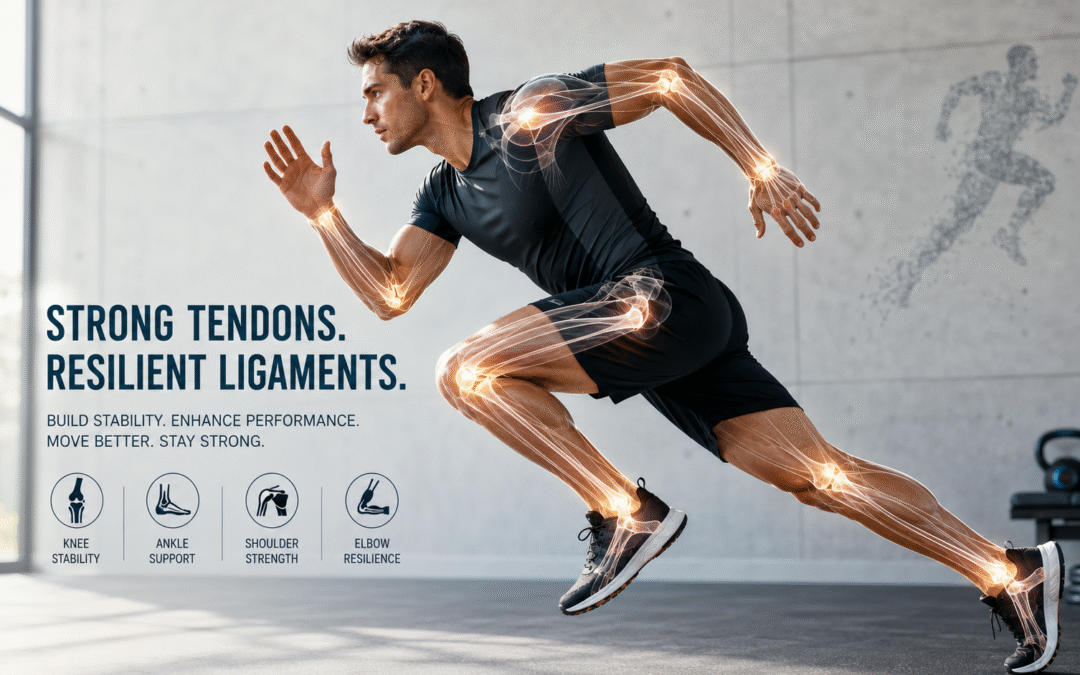
How to Strengthen Tendons and Ligaments for Sport
Most athletes train their muscles, fitness and sporting skills. However, fewer athletes deliberately consider how to strengthen tendons and ligaments.
These connective tissues play an essential role in transferring force, stabilising joints and helping the body tolerate running, jumping, lifting and changing direction. They also adapt differently from muscle and may need more time to adjust when training demands increase.
A well-designed tendon and ligament training program does not rely on one special exercise. Instead, it uses progressive strength training, controlled exposure to faster movements and enough recovery for the tissues to adapt.
This article explains:
- how tendons and ligaments differ from muscles
- which loading methods may improve tendon capacity
- how athletes should progress their training
- how ligament conditioning differs from tendon training
- which common training mistakes may increase injury risk
What Is the Difference Between Tendons and Ligaments?
Tendons and ligaments are both made primarily from collagen-rich connective tissue, but they perform different roles.
Tendons connect muscles to bones. They transfer the force produced by a muscle so that a joint can move. Examples include the Achilles tendon, patellar tendon and rotator cuff tendons.
Ligaments connect bones to other bones. They help guide movement and provide stability around a joint. Examples include the anterior cruciate ligament in the knee and the lateral ankle ligaments.
Although both tissues respond to mechanical loading, tendon adaptation has been studied more extensively in humans. Research into ligament adaptation is more limited and often relates to injury rehabilitation rather than deliberately strengthening an uninjured ligament.
Why Do Tendons Adapt Differently From Muscles?
Tendons have a blood supply, but their metabolic turnover and circulation are lower than those of skeletal muscle. As a result, changes in tendon structure and mechanical properties may occur more slowly than improvements in muscle strength or coordination.
Research has found that muscle function can improve before measurable changes occur in tendon stiffness or structure. In some studies, tendon changes became clearer after approximately two to three months of consistent resistance training.
Therefore, an athlete may feel stronger and fitter before the tendon has fully adapted to the new level of force being produced.
This does not mean that tendons are fragile. Tendons are highly responsive to appropriate mechanical loading. However, meaningful adaptation requires consistency, sufficient training intensity and time.
How to Strengthen Tendons and Ligaments
Athletes who want to strengthen tendons and ligaments should focus on five main principles.
1. Apply Sufficient Mechanical Load
Connective tissue needs mechanical loading to maintain and improve its capacity.
Very light exercise may improve movement confidence or circulation, but it may not provide enough stimulus to produce meaningful changes in tendon stiffness.
Research suggests that the magnitude of the load placed through a tendon is more important than whether the contraction is isometric, concentric or eccentric.
In practical terms, athletes should gradually progress towards exercises that are physically challenging while maintaining appropriate control and technique.
2. Increase Load Gradually
Tendons respond positively when training load is progressed at a manageable rate. However, sudden changes in running distance, jumping volume, resistance, speed or training frequency can exceed the athlete’s current capacity.
Training load is only one part of injury risk, and no single formula can accurately predict whether an athlete will become injured. Nevertheless, large and poorly managed changes in activity may increase risk, particularly when combined with poor recovery, previous injury or inadequate physical preparation.
Useful progression options include increasing:
- resistance
- repetitions
- sets
- range of movement
- movement speed
- training frequency
- running or jumping volume
- sport-specific complexity
Avoid increasing several of these variables substantially at the same time.
3. Train Consistently
Tendon adaptation is driven by repeated exposure rather than occasional intense sessions.
A consistent program completed over several months is more likely to improve tissue capacity than irregular periods of heavy training followed by long breaks.
Consistency is particularly important during:
- preseason preparation
- return from injury
- return from an off-season
- increases in running distance
- changes in playing level
- changes in competition frequency
There is no universal preseason length that suits every athlete. The appropriate timeframe depends on the sport, the athlete’s training history, previous injuries and the demands of competition.
4. Progress From Slow Strength to Faster Loading
Heavy resistance training can help build force capacity. However, many sports also require tendons to store and release energy quickly.
For example, the Achilles tendon is exposed to rapid force during sprinting and jumping. Slow calf raises may develop strength, but they do not fully prepare an athlete for repeated high-speed running.
A complete program should usually progress through several stages:
- controlled strength exercises
- heavier resistance exercises
- faster strength movements
- hopping, jumping or landing tasks
- sprinting, cutting or sport-specific drills
Not every athlete needs every stage. The progression should reflect the actual demands of the athlete’s sport.
5. Monitor the Response to Training
Training should create enough stress to stimulate adaptation without repeatedly producing a significant flare-up.
Athletes should monitor:
- pain during exercise
- pain or stiffness later that day
- symptoms the following morning
- changes in strength or movement
- ability to complete normal training
- recovery between sessions
A small amount of discomfort may be acceptable during some tendon rehabilitation programs. However, pain should not continually increase, substantially alter movement or become progressively worse from one session to the next.
Which Tendon Loading Exercises Work?
There is no single best method for every tendon or every athlete.
Isometric, eccentric, concentric and heavy slow resistance exercises can all play a role. The most appropriate method depends on the athlete’s symptoms, current capacity, training stage and sporting goals.
Isometric Loading
An isometric exercise involves creating muscle tension without visible joint movement.
Examples include:
- holding a calf raise
- holding a wall sit
- holding a split squat
- pushing or pulling against an immovable resistance
Isometric exercises can be useful when an athlete needs to maintain strength while limiting joint movement. They may also be used during an early rehabilitation stage when dynamic exercise is uncomfortable.
Some athletes experience short-term pain relief following isometric exercise. However, this response is not universal, and isometrics should not be presented as a guaranteed way to reduce tendon pain.
Isometric training is usually one component of rehabilitation rather than the complete long-term solution.
Eccentric Loading
An eccentric contraction occurs when a muscle produces force while lengthening.
Examples include:
- slowly lowering from a calf raise
- lowering into a squat
- controlling the downward phase of a hamstring curl
- slowly lowering a weight during a shoulder exercise
Eccentric exercise has been widely used in Achilles, patellar and other tendon rehabilitation programs.
It can improve strength, pain and function. However, current evidence does not show that eccentric exercise is always superior to every other loading method.
Athletes should not assume that the lowering phase is the only part of an exercise that matters.
Heavy Slow Resistance Training
Heavy slow resistance training involves completing both the lifting and lowering phases of an exercise under substantial resistance and at a controlled speed.
Examples may include:
- weighted calf raises
- leg press
- squats
- split squats
- knee extensions
- hamstring curls
- shoulder presses or pulling exercises
The resistance should be challenging enough to stimulate adaptation while still allowing the athlete to complete the exercise with control.
Heavy slow resistance training can improve tendon mechanical properties, strength and function. It may also be easier to progress than an eccentric-only program because load can be increased gradually across the full exercise.
For many athletes, heavy slow resistance is an effective foundation before progressing to faster and more sport-specific movements.
Plyometric and Energy-Storage Loading
Plyometric exercises expose the muscle-tendon unit to force at higher speeds.
Examples include:
- skipping
- pogo jumps
- hopping
- bounding
- landing drills
- acceleration drills
- sprinting
These exercises are particularly relevant for field, court and running athletes.
Plyometric training should not normally be the first stage of a painful tendon rehabilitation program. Before introducing it, the athlete should usually demonstrate adequate strength and tolerance to slower loading.
The volume and intensity should then increase gradually.
Does a Stiffer Tendon Improve Performance?
Resistance training can increase tendon stiffness, material properties and, in some cases, tendon cross-sectional area.
Within an appropriate range, tendon stiffness may help transmit muscular force efficiently. This can contribute to force production and sporting movements such as running and jumping.
However, “stiffer” does not automatically mean “better” in every situation. Different tendons perform different roles, and athletic performance depends on the interaction between muscle strength, tendon properties, coordination and technique.
The goal is not simply to make a tendon as stiff as possible. The goal is to develop a muscle-tendon unit that can tolerate and transfer the forces required by the athlete’s sport.
How Do You Strengthen Ligaments?
Ligaments cannot be isolated and strengthened in the same way as a biceps or quadriceps muscle.
Instead, ligament conditioning is supported by exposing the surrounding joint to appropriately progressed forces while improving muscular strength, movement control and sport-specific capacity.
A ligament-focused program may include:
- strength training through an appropriate range of movement
- balance and proprioception exercises
- landing and deceleration training
- change-of-direction drills
- single-leg strength exercises
- perturbation or stability exercises
- gradual exposure to sport-specific movements
For example, reducing knee ligament injury risk may involve strengthening the hips and legs, improving landing control and gradually introducing cutting and pivoting tasks.
Following a ligament injury or surgical reconstruction, loading must also respect the tissue’s stage of healing. Exercise selection should be based on the injured structure, joint position, amount of force and the athlete’s response.
A program suitable for an uninjured athlete may not be appropriate for someone recovering from an anterior cruciate ligament or ankle ligament injury.
What Do Athletes Commonly Get Wrong?
Doing Too Much Too Soon
A common mistake is substantially increasing running, jumping, lifting or competition exposure before the body is prepared.
Training load should be built progressively rather than compressed into a short preseason or return-to-sport period.
Relying Only on Stretching
Stretching can improve movement or provide temporary symptom relief, but it does not replace progressive strength training.
Tendons and ligaments need exposure to force, not only flexibility exercises.
Using Only Light Resistance
High-repetition exercises with very light resistance can be useful during some stages of rehabilitation. However, athletes eventually need sufficient resistance to prepare the tissues for higher sporting loads.
Stopping as Soon as Pain Improves
Pain may improve before strength, endurance and sport-specific capacity have been restored.
Returning immediately to full training can expose the tissue to demands it has not yet rebuilt the capacity to tolerate.
Completing Strength Training Without Sport-Specific Loading
Slow resistance exercises are important, but they may not fully prepare an athlete for sprinting, jumping, landing or changing direction.
The final stages of training should reflect the speed, force and repetition required in the athlete’s sport.
Training Through Progressively Worsening Pain
Some discomfort may be manageable, but steadily increasing pain is not a sign that an athlete should simply push harder.
A significant or persistent reaction may indicate that the exercise, total workload or recovery period needs to change.
Example Tendon Training Progression
A general progression may look like this:
Stage 1: Controlled Loading
- isometric holds
- light-to-moderate resistance
- comfortable range of movement
- reduction of unnecessary aggravating activity
Stage 2: Progressive Strength
- heavier resistance
- slow lifting and lowering
- full or gradually increasing range
- single-leg or single-arm variations where appropriate
Stage 3: Faster Force Production
- quicker resistance exercises
- moderate hopping or jumping
- controlled landing
- increased movement complexity
Stage 4: Sport-Specific Loading
- sprinting
- repeated jumping
- cutting and changing direction
- throwing or striking
- return to training drills
- gradual return to competition
Progression should be based on strength, symptoms and performance rather than time alone.
When Should an Athlete Seek Assessment?
Consider consulting a physiotherapist, exercise physiologist, sports scientist or other suitably qualified practitioner if:
- pain continues for more than a few weeks
- pain is becoming progressively worse
- symptoms return whenever training increases
- morning stiffness is increasing
- strength or performance is declining
- pain affects walking, running or jumping
- the joint feels unstable
- there was a sudden injury, pop or loss of function
- you are unsure how to progress your exercises
- you are returning from a tendon or ligament injury
A clinical assessment can help distinguish between normal training soreness, tendon pain, ligament injury and other possible causes of symptoms.
Frequently Asked Questions
How long does it take to strengthen tendons?
Early changes in tendon properties may occur within several weeks, but meaningful improvements usually require consistent loading over several months.
The timeframe depends on the tendon being trained, exercise intensity, training history, age and recovery.
What is the best exercise for strengthening tendons?
There is no single best tendon exercise.
The most effective exercise is one that places sufficient load through the relevant tendon, can be progressed over time and matches the athlete’s current capacity.
Are isometric or eccentric exercises better for tendons?
Both can be useful.
Research suggests that loading magnitude and progression may be more important for tendon adaptation than the contraction type alone. Many programs combine isometric, eccentric and concentric loading.
Can running strengthen tendons?
Running loads the tendons of the lower limb and can contribute to sport-specific capacity.
However, running alone may not provide the controlled, progressive resistance required to address a strength deficit or rehabilitate a painful tendon.
Can ligaments become stronger?
Ligaments respond to mechanical loading, but direct human evidence is less extensive than the evidence for tendon adaptation.
Strength, balance, landing and sport-specific exercises can improve the capacity of the joint and the muscles surrounding the ligament.
Should tendon exercises hurt?
Some rehabilitation programs allow mild discomfort during exercise. However, pain should remain manageable and should not progressively worsen during the session or over the following day.
Exercise should be modified when symptoms are severe, escalating or affecting normal movement.
Build Stronger Tendons and Ligaments at IOSAS
Learning how to strengthen tendons and ligaments involves more than completing one type of exercise.
Athletes need progressive resistance training, adequate recovery and gradual exposure to the speed and forces required by their sport. The appropriate program will vary according to the tissue involved, the athlete’s training history and whether pain or injury is already present.
The team at the Institute of Sports and Spines in Tingalpa works with recreational, competitive and elite athletes to assess strength, manage training load and develop structured rehabilitation and performance programs.
Book online or call 07 3398 7022 to arrange an assessment.
Institute of Sports and Spines
1566 Wynnum Road, Tingalpa QLD 4173
instituteofsportsandspines.com.au
This article provides general information only. It does not replace individual medical assessment, diagnosis or treatment.
References
Bohm, S., Mersmann, F., and Arampatzis, A. (2015). Human tendon adaptation in response to mechanical loading: A systematic review and meta-analysis of exercise intervention studies on healthy adults. Sports Medicine – Open, 1, 7. DOI: 10.1186/s40798-015-0009-9.
Kubo, K., Ikebukuro, T., Yata, H., Tsunoda, N., and Kanehisa, H. (2010). Time course of changes in muscle and tendon properties during strength training and detraining. Journal of Strength and Conditioning Research, 24(2), 322–331. DOI: 10.1519/JSC.0b013e3181c865e2.
Lazarczuk, S. L., Maniar, N., Opar, D. A., and Duhig, S. J. (2022). Mechanical, material and morphological adaptations of healthy lower-limb tendons to mechanical loading: A systematic review and meta-analysis. Sports Medicine, 52, 2405–2429. DOI: 10.1007/s40279-022-01695-y.
Li, Y., et al. (2024). Mixed comparison of intervention with eccentric, isometric and heavy slow resistance exercise for adults with patellar tendinopathy: A systematic review and network meta-analysis. Heliyon, 10(21), e39171. DOI: 10.1016/j.heliyon.2024.e39171.
Logerstedt, D. S., et al. (2022). Effects of and response to mechanical loading on the knee. Sports Medicine, 52(2), 201–235. DOI: 10.1007/s40279-021-01579-7.
Silbernagel, K. G., Hanlon, S., and Sprague, A. (2020). Current clinical concepts: Conservative management of Achilles tendinopathy. Journal of Athletic Training, 55(5), 438–447. DOI: 10.4085/1062-6050-356-19.
Recent Comments