

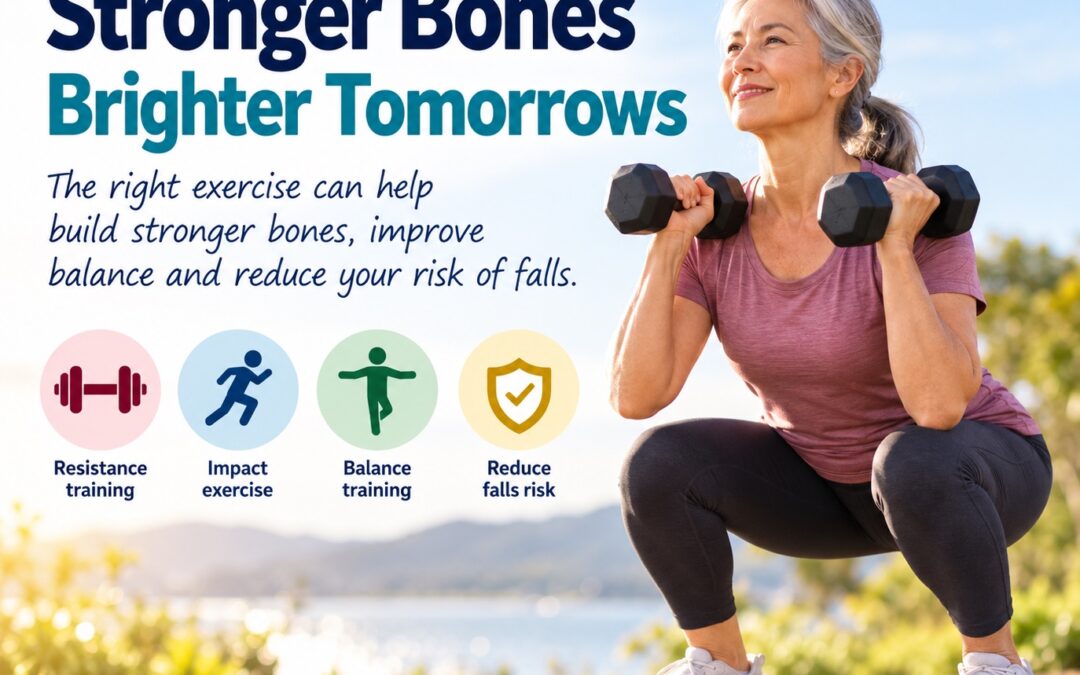
Exercise for Osteoporosis: Can the Right Exercise Actually Build Stronger Bones?
By James Chen,
If you have been diagnosed with osteoporosis or osteopenia, you may have heard the same advice many times:
“Stay active and get plenty of exercise.”
Staying active is certainly important. However, when it comes to improving bone strength and reducing fracture risk, not all exercise is equal. Research increasingly shows that the type, intensity and progression of exercise matter.
So, can the right exercise actually help build stronger bones?
The answer is encouraging.
Why Is Exercise Important for Osteoporosis?
Osteoporosis occurs when bones become less strong and more vulnerable to fracture. While we cannot simply exercise our way out of every case of osteoporosis, appropriately prescribed exercise can play an important role in osteoporosis management.
The right exercise program can help:
- stimulate and maintain bone strength
- increase muscle strength
- improve balance
- improve mobility and physical function
- reduce the risk of falls
- improve confidence with everyday activities
However, achieving these benefits requires more than simply telling someone to “exercise more”.
What Exercise Doesn’t Work as Well for Building Bone?
Walking is excellent exercise. It can improve cardiovascular fitness, mobility, general health and independence. However, walking alone may not provide enough loading to maximise improvements in bone mineral density, particularly at important sites such as the spine.
Swimming and cycling are also excellent cardiovascular activities. However, because your body is supported during these activities, they provide relatively little weight-bearing skeletal loading.
Likewise, stretching and very light resistance exercise can have benefits for mobility and general conditioning but may not provide enough stimulus to significantly improve bone strength. That doesn’t make walking, swimming or cycling “bad” exercises. It simply means that your bones may need a different type of stimulus if improving bone strength is the goal.
Can Exercise Increase Bone Density?
Bone is living tissue. Like muscle, it responds to the demands placed upon it.
When bones are exposed to an appropriate mechanical load, they can adapt. Importantly, this response is site-specific, meaning the bones being loaded are the bones most likely to benefit. This is why exercise programs designed for osteoporosis generally include targeted resistance training and weight-bearing loading, rather than relying on general physical activity alone.
One of the most influential studies in this area was the LIFTMOR trial.
What Did the LIFTMOR Osteoporosis Study Find?
The LIFTMOR trial investigated high-intensity resistance and impact training in postmenopausal women with low bone mass.
Participants completed approximately 30 minutes of supervised exercise twice per week for eight months.
The program included progressively loaded resistance exercises performed at greater than approximately 85% of one-repetition maximum (1RM).
Compared with a low-intensity exercise group, the high-intensity group experienced an improvement in lumbar spine bone mineral density of approximately 2.9%, while the comparison group experienced a reduction of approximately 1.2%. Femoral neck bone mineral density was also better maintained in the high-intensity training group.
The study provides an important message:
Bones need sufficient loading to adapt.
How Heavy Should You Exercise With Osteoporosis?
This is where exercise for osteoporosis becomes particularly interesting. The LIFTMOR program was not based on very light weights.
Participants progressed to 5 sets of 5 repetitions at greater than 85% of their one-repetition maximum.
Exercises used in osteoporosis research have included movements such as:
- deadlifts
- squats
- overhead presses
- jumping or impact exercises
- balance exercises
However, this does not mean that someone diagnosed with osteoporosis should walk into a gym tomorrow and start performing heavy deadlifts or jumping exercises. That would completely miss one of the most important aspects of the research. These exercise programs were progressive, individualised and supervised.
Before higher-load exercise is introduced, factors such as previous fractures, bone density, strength, balance, exercise experience, medical conditions and movement ability should be considered.
Is Heavy Strength Training Safe With Osteoporosis?
For appropriately selected people, progressive resistance training can form an important part of an osteoporosis exercise program. But the starting point will be different for every person.
Someone who has exercised regularly for many years may be able to progress relatively quickly.
Another person may have:
- significant osteoporosis
- previous vertebral fractures
- poor balance
- limited strength
- joint problems
- other medical conditions
- little previous resistance-training experience
Their program may need to begin much more gradually. The goal is not simply to lift heavy weights.
The goal is to progressively expose the bones and muscles to an appropriate level of loading while maintaining good technique and managing fracture risk.
Exercise vs Osteoporosis Medication: Which Is Better?
It shouldn’t necessarily be exercise OR medication.
They perform different roles. Osteoporosis medications can substantially reduce fracture risk in people who are considered at increased risk of minimal-trauma fractures.
Exercise addresses several important factors that medication cannot address on its own.
A well-designed osteoporosis exercise program can improve:
- muscle strength
- balance
- coordination
- mobility
- physical function
- confidence with movement
Appropriately prescribed loading may also help maintain or improve bone strength.
For many people, effective osteoporosis management therefore involves a combination of medical management, nutrition, appropriate exercise and falls prevention.
Strong Bones Are Only Half the Story: Preventing Falls
Bone strength is extremely important, but fracture prevention involves more than bone density. A fracture frequently occurs when weakened bones meet a fall.
Reducing falls risk is therefore an essential part of osteoporosis management.
Factors that may increase the risk of falling include:
- reduced leg strength
- poor balance
- reduced mobility
- some medications
- impaired vision
- neurological or medical conditions
- hazards around the home or environment
This is why osteoporosis management should not focus solely on the result of a DXA bone density scan.
We also need to consider how well someone can stand, walk, react, balance and move safely during everyday life.
What Are the Best Exercises for Osteoporosis?
Current Australian guidance supports combining several different types of exercise rather than relying on just one.
1. Progressive Resistance Training
Resistance training helps strengthen both muscles and bones.
Exercises might include movements such as:
- squats
- deadlift variations
- lunges
- pulling exercises
- pressing exercises
- step-ups
The resistance should gradually increase as strength and technique improve.
2. Weight-Bearing and Impact Exercise
Weight-bearing activities expose the skeleton to forces that can help stimulate bone.
Depending on the person’s fracture risk and physical capacity, this may include:
- brisk walking
- stair climbing
- stepping exercises
- hopping
- jumping
- multidirectional movements
Impact exercise is not appropriate for everyone, particularly without assessment.
3. Balance Training
Balance training is extremely important because stronger bones alone cannot completely protect someone from fractures if they are frequently falling.
Balance exercises should progressively challenge the body’s ability to remain stable.
This might involve:
- reducing the base of support
- standing on one leg
- changing direction
- reaching
- stepping
- dynamic balance activities
- dual-task exercises
The exercise needs to be challenging enough to improve balance while still being performed safely.
Can You Exercise If You Already Have Osteoporosis?
In most cases, having osteoporosis does not mean you should avoid exercise. In fact, remaining physically active is an important part of managing osteoporosis.
However, your program may need to be modified if you have a history of fractures, particularly spinal fractures, or other medical or musculoskeletal conditions. Certain movements involving loaded or excessive spinal flexion and twisting may not be appropriate for some people with osteoporosis.
This is another reason an individual assessment is valuable before beginning a more intensive osteoporosis exercise program.
Exercise for Osteoporosis: Train for the Right Purpose
The key message is simple:
Don’t just exercise more. Exercise for the right purpose.
For someone with osteoporosis or osteopenia, a well-designed exercise program should aim to:
- appropriately load the bones
- progressively strengthen the muscles
- challenge balance
- maintain mobility
- improve physical function
- reduce falls risk
The program should also take into account your bone density, fracture history, medical conditions, exercise experience and individual goals.
Need Help Starting an Osteoporosis Exercise Program?
If you have osteoporosis or osteopenia and aren’t sure where to begin, an Accredited Exercise Physiologist (AEP) can assess your strength, balance, mobility, exercise capacity and falls risk.
From there, they can develop a safe and progressive exercise program specifically designed around your needs.
At Institute of Sports and Spines in Tingalpa, our Exercise Physiology team can help people with osteoporosis and osteopenia develop appropriate strength, balance and bone-loading programs.
Rather than simply telling you to “exercise more”, the aim is to determine which exercises, how much load and what level of progression are appropriate for you.
Contact us on (07) 3398 7022 to find out more about our osteoporosis exercise and balance programs in Brisbane, or click here to book your appointment now!
Recent Comments