

Parkinson’s Disease: Can the Right Exercise Improve Movement and Maintain Independence?
By James Chen
If you or someone you love has Parkinson’s disease, you may wonder whether exercise can help manage symptoms and maintain independence.
Medication plays an essential role in managing Parkinson’s disease. However, Parkinson’s disease exercise is also an important part of treatment. Research shows that appropriately prescribed exercise can improve walking, balance, muscle strength and everyday movement.
For many people, these improvements can make daily activities easier and help maintain confidence and independence.
But what type of exercise works best? Can exercise slow Parkinson’s disease progression? And is walking enough?
Let’s explore what the research tells us.
How Does Parkinson’s Disease Affect Movement?
Parkinson’s disease is a progressive neurological condition that affects the brain’s ability to control movement.
The condition involves the gradual loss of nerve cells that produce dopamine, a chemical messenger that helps coordinate smooth, controlled movements.
Common movement-related symptoms include:
- Tremor: Involuntary shaking, often affecting the hands.
- Rigidity: Muscle stiffness that can restrict movement.
- Bradykinesia: Slowness of movement, making everyday tasks more difficult.
- Balance difficulties: Reduced stability and an increased risk of falls.
- Walking changes: Shorter steps, reduced arm swing and difficulty turning.
Some people also experience freezing of gait, where their feet temporarily feel stuck to the ground despite wanting to walk.
As Parkinson’s disease progresses, everyday activities such as standing from a chair, getting out of bed or walking through a doorway may become more challenging.
Fortunately, targeted exercise can help address many of these movement difficulties.
Can Exercise Slow Parkinson’s Disease Progression?
One of the most important questions researchers continue to investigate is whether exercise can slow Parkinson’s disease progression.
Although exercise cannot cure Parkinson’s disease or reverse the loss of dopamine-producing nerve cells, research suggests that physical activity may support brain health and improve movement control.
One possible mechanism involves neuroplasticity.
Neuroplasticity refers to the brain’s ability to adapt and reorganise its connections through learning, practice and repeated activity.
Regular exercise may encourage these adaptations, particularly when movements are challenging, repetitive and progressively developed.
However, there is an important distinction.
Exercise can improve Parkinson’s symptoms and physical function, but researchers have not yet established whether it directly slows the underlying neurodegenerative process.
Even without definitive evidence of disease modification, improving strength, balance, walking and functional movement can make a meaningful difference to everyday life.
What Does Research Say About Parkinson’s Disease Exercise?
Research increasingly supports exercise as an important component of Parkinson’s disease management.
A systematic review and meta-analysis by Zhen et al. (2022) examined 20 studies investigating aerobic exercise in people with Parkinson’s disease.
The researchers found improvements in several important physical outcomes, including:
- Walking speed and step length.
- Balance and postural control.
- Timed Up and Go (TUG) performance.
- Six-minute walking distance.
- Motor symptoms measured using the Unified Parkinson’s Disease Rating Scale (UPDRS-III).
For example, the researchers reported a significant improvement in Timed Up and Go performance, with a standardised mean difference of −0.41.
The Timed Up and Go test measures how quickly someone can stand from a chair, walk a short distance, turn around and sit down again.
Consequently, improvements in this test may reflect better functional mobility during everyday activities.
However, the review did not find significant improvements in every outcome, including its pooled measure of quality of life.
The key message: Aerobic exercise can improve important aspects of walking, balance and movement. Nevertheless, the benefits vary depending on the individual, exercise program and outcome being measured.
Is Walking Enough for Parkinson’s Disease?
Walking is an excellent form of physical activity. It helps maintain cardiovascular fitness, endurance and general mobility.
However, walking alone may not address every movement difficulty associated with Parkinson’s disease.
For example, some people experience:
- Shorter or shuffling steps.
- Reduced arm swing.
- Difficulty starting or stopping movement.
- Problems turning or changing direction.
- Freezing of gait.
- Reduced balance and postural control.
These difficulties often require more targeted exercise strategies.
A review by Keus et al. (2007) highlighted several important approaches to Parkinson’s rehabilitation, including external cueing, cognitive movement strategies, balance training and exercises to improve mobility and physical capacity.
How Can Movement Cues Help?
External cues provide additional information that can help someone initiate or coordinate movement.
Examples include:
- Walking to a steady rhythm or metronome.
- Following visual markings on the floor.
- Using verbal reminders to take larger steps.
- Practising deliberate turning and stepping strategies.
These techniques can be particularly useful when movement becomes slow, hesitant or difficult to initiate.
Therefore, an effective Parkinson’s exercise program should focus not only on how much someone moves, but also on how effectively they move.
Can Strength and Balance Training Improve Freezing of Gait?
Freezing of gait is one of the more challenging movement symptoms associated with Parkinson’s disease.
It can occur when starting to walk, turning, approaching a doorway or moving through crowded spaces.
Fortunately, research suggests that targeted exercise may help.
A randomised controlled trial by Silva-Batista et al. (2020) investigated exercise in people with Parkinson’s disease who experienced freezing of gait.
The researchers compared traditional motor rehabilitation with a more challenging approach called adapted resistance training with instability.
Participants exercised three times per week for 12 weeks.
The adapted resistance training program combined strengthening exercises, such as squats and lunges, with carefully supervised balance and movement challenges.
What Did the Researchers Find?
Compared with traditional motor rehabilitation, the adapted resistance training group demonstrated greater improvements in several important outcomes.
The researchers reported:
- A 4.4-point reduction in the New Freezing of Gait Questionnaire score, indicating improvement in freezing-related difficulties.
- A 7.4-point reduction in the UPDRS-III motor symptom score, indicating improved motor function.
- Improvements in movement preparation, freezing-related performance and reported quality of life.
- Changes in brain activation associated with movement control.
These findings are encouraging because they suggest that appropriately challenging exercise may improve both physical performance and aspects of neurological movement control.
However, the study involved a relatively small number of participants. Therefore, its results should not be interpreted as a guarantee that resistance training will reduce freezing of gait for everyone.
Importantly, exercises involving instability require professional supervision, particularly when balance or fall risk is a concern.
What Type of Exercise Is Best for Parkinson’s Disease?
There is no single exercise that works best for everyone.
Instead, research and clinical guidelines support combining several types of exercise to address different movement difficulties.
Parkinson’s Australia and the Parkinson’s Foundation recommend programs that include aerobic activity, resistance training, flexibility and balance-related exercises.
1. Aerobic Exercise for Fitness and Walking
Aerobic exercise improves cardiovascular fitness, endurance and physical capacity.
Examples include:
- Brisk walking.
- Stationary cycling.
- Swimming or aquatic exercise.
- Dancing.
- Other suitable cardiovascular activities.
Aerobic exercise may also improve walking speed, step length and certain motor symptoms.
However, people who experience freezing of gait or significant balance difficulties may benefit from supported or stationary exercise options.
2. Resistance Training for Strength and Independence
Muscle strength is essential for everyday activities such as standing, climbing stairs, lifting objects and maintaining mobility.
A Parkinson’s strength training program may include:
- Sit-to-stand exercises.
- Squats.
- Step-ups.
- Leg strengthening exercises.
- Resistance bands or gym-based weights.
- Upper-body and postural strengthening.
Progressive resistance training can improve muscular strength and physical capacity.
Furthermore, stronger muscles may help people perform everyday movements with greater confidence and less physical effort.
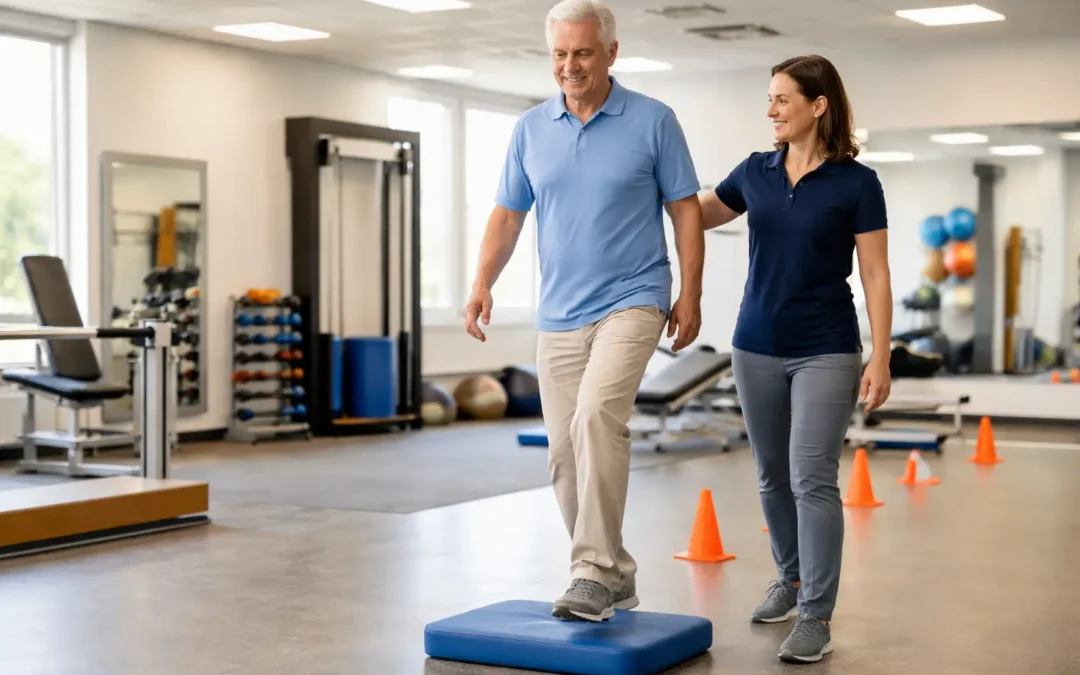
3. Balance Training to Improve Stability
Parkinson’s disease can affect the body’s ability to maintain balance and respond to changes in position.
Targeted balance exercises may include:
- Controlled weight shifting.
- Stepping in different directions.
- Practising safe turning techniques.
- Standing balance challenges.
- Reaching and movement coordination activities.
As balance improves, an exercise physiologist may gradually introduce more challenging activities.
However, exercise difficulty must match the individual’s ability and fall risk.
4. Gait and Movement Training for Better Walking
Gait training focuses on improving how someone walks rather than simply increasing walking distance.
Exercises may involve:
- Practising larger, more deliberate steps.
- Improving arm swing.
- Walking with rhythmic cues.
- Changing direction safely.
- Practising movement initiation and stopping.
- Rehearsing everyday walking tasks.
These strategies may help improve movement efficiency and confidence.
For people with significant freezing of gait or recurrent falls, specialist neurological physiotherapy input may also be appropriate.
5. Flexibility and Mobility Exercises for Stiffness
Muscle stiffness and reduced joint movement can make everyday activities more difficult.
Flexibility and mobility exercises may help maintain movement around the spine, shoulders, hips and other joints.
For example, a program may include gentle stretching, trunk rotation, shoulder mobility and controlled movement through comfortable ranges.
Although stretching alone is unlikely to address every Parkinson’s symptom, it can complement strength, balance and aerobic exercise.
How Often Should Someone With Parkinson’s Disease Exercise?
Exercise frequency depends on the individual’s symptoms, fitness, mobility and medical considerations.
However, Parkinson’s Australia and the Parkinson’s Foundation provide useful general recommendations.
These include:
- Aerobic exercise: At least 30 minutes, three times per week.
- Strength training: At least two sessions per week.
- Balance and agility training: Two to three sessions per week.
- Flexibility exercises: Two to three sessions per week, with more frequent movement where appropriate.
These recommendations provide a general target rather than a starting point for everyone.
For someone with reduced mobility, fatigue or significant balance difficulties, shorter sessions and gradual progression may be more appropriate.
Exercise programs should also consider medication timing, changes in blood pressure, freezing of gait and individual safety.
Consistency matters, but so does choosing the right exercises and progressing them appropriately.
Can Parkinson’s Disease Exercise Help Maintain Independence?
For someone living with Parkinson’s disease, exercise is about much more than improving fitness.
It is about maintaining the ability to perform everyday activities.
These may include:
- Getting out of bed independently.
- Standing from a chair.
- Walking safely around the home.
- Shopping and participating in community activities.
- Managing stairs and changes in direction.
- Maintaining confidence during daily movement.
Even relatively small improvements in mobility, balance or strength may help someone continue activities that are important to them.
Furthermore, participating in regular exercise can provide structure, social interaction and opportunities to maintain physical confidence.
Although Parkinson’s disease is progressive, exercise offers a practical way to address many of the physical challenges associated with the condition.
How Can an Exercise Physiologist Help With Parkinson’s Disease?
An Accredited Exercise Physiologist (AEP) can help people living with Parkinson’s disease participate in safe, structured and progressive exercise.
An individual assessment may examine:
- Muscle strength and endurance.
- Balance and fall risk.
- Walking ability and functional mobility.
- Posture and movement coordination.
- Cardiovascular fitness.
- Daily activities and personal goals.
Based on these findings, an exercise physiologist can develop a program that addresses the individual’s needs and abilities.
As symptoms or physical capacity change, the program can be adjusted to maintain an appropriate level of challenge.
Exercise physiology may also complement care provided by neurologists, general practitioners, physiotherapists and other healthcare professionals.
Parkinson’s Disease Exercise at Institute of Sports and Spines
At the Institute of Sports and Spines in Tingalpa, Brisbane, our Exercise Physiology services focus on improving strength, balance, mobility and functional movement.
Our rehabilitation gym provides an environment where exercise programs can be individually prescribed, supervised and progressively developed.
For people living with Parkinson’s disease, our approach focuses on identifying movement difficulties, improving physical capacity and supporting everyday independence.
The goal is simple: Don’t just exercise more—exercise for the movements that matter.
If you or someone you care for is living with Parkinson’s disease, an individual exercise assessment may help identify practical ways to improve movement confidence, physical function and quality of life.
Contact Institute of Sports and Spines to learn more about our Exercise Physiology services and how a tailored exercise program may help, OR click here to make an appointment.
References and Further Reading
- Zhen, K., Zhang, S., Tao, X., et al. (2022). A systematic review and meta-analysis on effects of aerobic exercise in people with Parkinson’s disease. npj Parkinson’s Disease, 8, 146.
https://doi.org/10.1038/s41531-022-00418-4 - Silva-Batista, C., et al. (2020). A randomized, controlled trial of exercise for Parkinsonian individuals with freezing of gait. Movement Disorders, 35(9), 1607–1617.
https://doi.org/10.1002/mds.28128 - Parkinson’s Australia. Exercise and Parkinson’s disease. Educational resources reviewed by Exercise & Sports Science Australia (ESSA).
https://www.parkinsons.org.au/information-hub/exercise/ - Keus, S. H. J., Bloem, B. R., Hendriks, E. J. M., Bredero-Cohen, A. B., & Munneke, M. (2007). Evidence-based analysis of physical therapy in Parkinson’s disease with recommendations for practice and research. Movement Disorders, 22(4), 451–460.
https://doi.org/10.1002/mds.21244
This article provides general educational information and does not replace individual medical advice. People living with Parkinson’s disease should discuss significant changes to their exercise program with their treating healthcare professionals, particularly where falls, cardiovascular symptoms or other medical concerns are present.
Recent Comments